
What NVIDIA’s GB300 Assembly Research Reveals About Force-Controlled Robotics
With AI infrastructure spending booming, the need to deliver the hardware that powers it is rising rapidly, and so are the demands on manufacturers.
Intricate electrical connections, precise mechanical interfaces, and increasingly complex assembly processes are making manual labor a growing bottleneck that stifles supply. Automating these delicate assembly tasks though requires more than programming a robot to follow a predefined path. Robots must respond intelligently to physical contact, adapt to variations, and handle delicate components with precision.
NVIDIA’s recent research into automated GB300 tester tray assembly(HYPERLINK) offers a compelling look at the future of electronics manufacturing. It shows the shift from purely position-controlled solutions to hybrid position- and force-controlled operation. In its research, NVIDIA’s Seattle Robotics Lab, working with the NVIDIA Isaac engineering team, explored how multiple robotic arms, machine vision, motion planning, and advanced control strategies could automate both busbar assembly and multi-connector insertion.
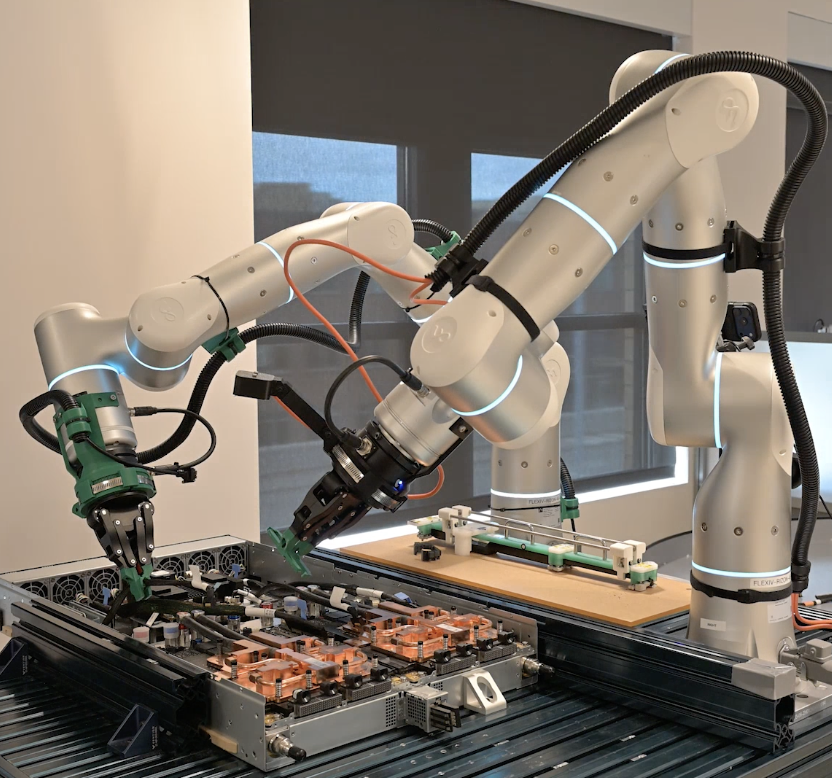
Their solution used two of Flexiv’s Rizon 4s adaptive robots along with a traditional collaborative robot. The systems worked together through NVIDIA’s Task and Agent Lifecycle Orchestration System (TALOS), which coordinates motion planning, manipulation primitives, and high-performance controllers. The inclusion of the adaptive robots was essential, as the assembly process required managing physical interactions, accommodating uncertainty, and regulating the forces applied during delicate operations.
While position-controlled robotics can get a robot to the location of a task, force control is what enables touch-sensitive tasks to be successfully completed.
1.WhyTraditionalAutomationStruggles withAIHardwareAssembly
NVIDIA’s GB300 assembly research was focused on verifying the functionality and performance of GB300 modules before being shipped. The testing process involves several operations that demand precision, dexterity, and controlled physical interaction.
The NVIDIA research team focused on two key challenges.
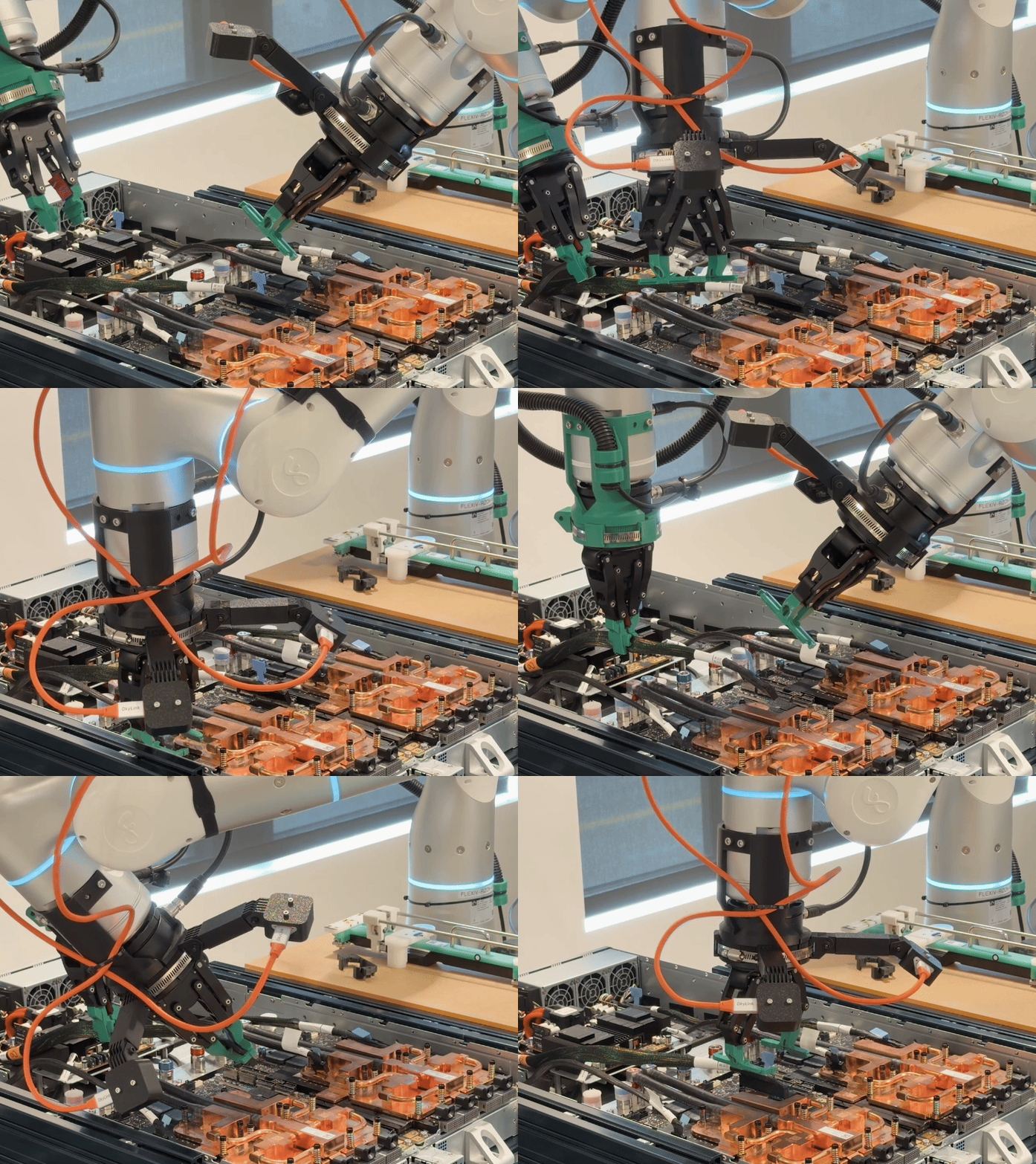
First was busbar assembly, in which the busbar is grasped, transported, and inserted into the tray before being secured with 16 screws. The process also requires inserting a limit fixture and later removing the fixture and busbar clamp.

Second was multi-connector insertion, in which two large and two small cable-mounted electrical connectors must be lifted, reoriented, and inserted into their corresponding sockets. These connectors have tight insertion clearances, delicate conductive pins, and cables that can be deformed or damaged during handling.
Traditional collaborative robots excel at executing repeatable trajectories in highly structured environments. Their performance can become erratic and unpredictable, however, when faced with the variances found in real-world production. Even on the strictest most controlled production line, conveyor drift, workpiece misalignment, fixture wear, and dimensional variability can introduce positional errors that lead to failure or workpiece damage.
For example, if a connector did not align perfectly with its socket, a programmed trajectory would cause the connector to collide with the socket edge rather than enter smoothly.
In highly structured manufacturing environments, these uncertainties are often handled through custom fixtures/jigs and mechanical constraints. Rapid product design cycles and changing production requirements, though, can make extensive fixed automation expensive and inflexible.
The challenge for manufacturers like NVIDIA is to develop robotic systems that maintain precision while being able to adapt to real-world variations.
2.What NVIDIA’s GB300 Research Shows
NVIDIA’s research combines established engineering practices with newer learning-based approaches. Rather than relying on a single methodology or technology, the researchers applied several capabilities across different stages of the assembly process:
a. Machine Vision and Pose Estimation: Identifying components and determining their positions and orientations.
b. Motion Planning: Generating collision-aware trajectories for grasping, positioning, and insertion.
c. Force and Impedance Control: Managing physical interaction during contact-sensitive operations.
d. Learning-based Manipulation: Improving performance on tasks where conventional control approaches proved insufficient.
e. Task Orchestration: Coordinating different robots, controllers, and manipulation processes.
Flexiv’s Rizon 4s adaptive robots played a pivotal role in the research. During busbar assembly, one Rizon 4s positioned a camera for pose estimation while the second handled insertion of the limit fixture and busbar, followed by removal of the clamp and fixture.
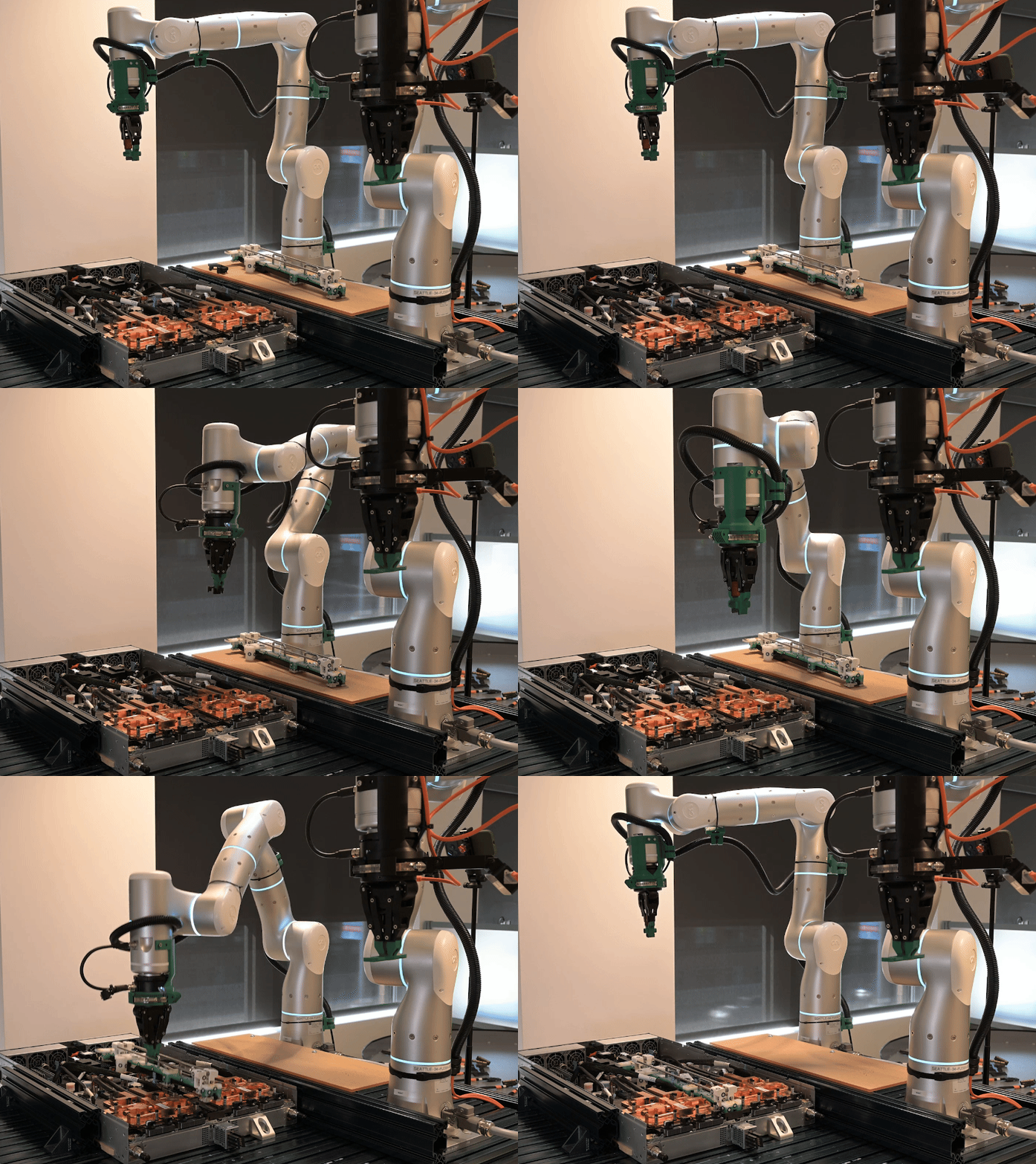
For multi-connector insertion, the two Rizon 4s arms coordinated to expose, grasp, reorient, and position the connectors before insertion. NVIDIA also developed learning-based insertion policies that used force-torque inputs to refine the final insertion process.
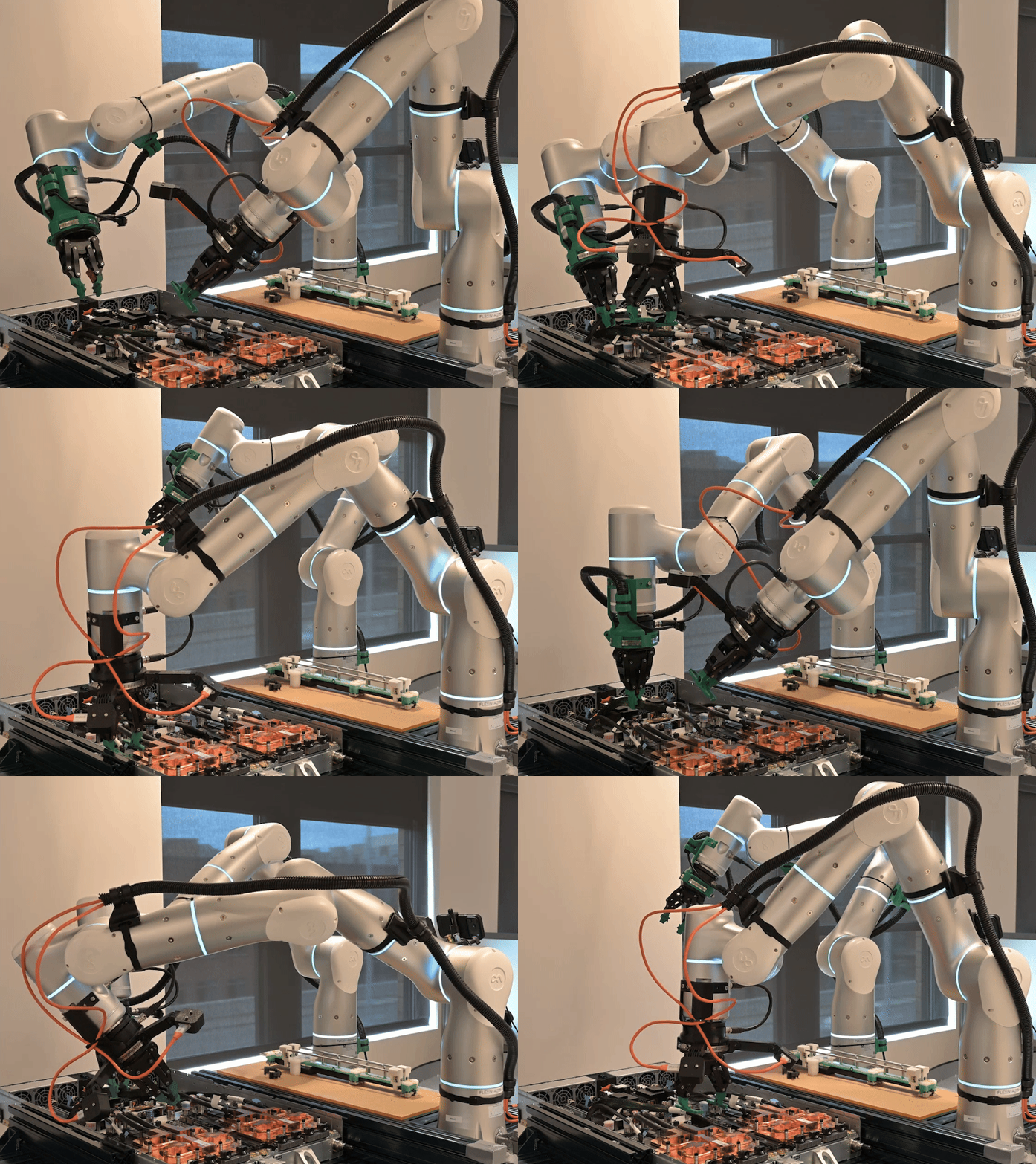
By including force-controlled robots, the research demonstrated how perception, mechanical design, motion planning, compliant control, and learning-based manipulation can work together to address complex real-world assembly challenges.
3.Why Force Control Matters
Imagine inserting a plug into a socket in the dark. For a human it's a trivial task, yet we are instantaneously judging and processing a vast amount of information.
We unconsciously track joint angles and muscle tension, guide our hands along a smooth trajectory, sense resistance when the prongs make contact, feel for the correct seating location, and monitor friction as we push the plug home. If we encounter unexpected feedback, such as hitting the edge of the socket, we “feel out” the correct insertion point. We even draw on task memory, understanding the approximate location of the insertion point relative to the socket housing, the force required for insertion, and the distance and maximum force that signal successful seating.
An adaptive robot executes the same methodology during an insertion task. Rather than relying exclusively on predefined positions and trajectories, it can dynamically respond to contact conditions. Depending on the control strategy, the robot can adjust its movement, accommodate small alignment errors, or initiate a recovery procedure when an unexpected obstruction is detected.
This capability is especially valuable for connector insertion, where small positional errors can cause a connector to catch against the socket rather than engage correctly.
In robotics this is commonly called compliance. A compliant robot can yield or adjust its movement in response to external forces instead of rigidly enforcing its planned trajectory. This is especially useful when inserting connectors, engaging mechanical interfaces, or handling components with variable positioning.
On the production line, as components and workpieces are rarely positioned with absolute perfection, even small variations in component placement, fixture tolerances, or cable positioning can affect assembly success. While computer vision can provide an initial estimate of position and orientation, visual data alone cannot account for the physical conditions encountered when two components make contact.
4.Improving Process Consistency and Production Efficiency
A common misconception is that compliant movement makes robotic tasks slower. While true that compliant motion on the whole is slower, what must be taken into account is that force-control improves overall process reliability by reducing failed insertions, excessive contact forces, and unnecessary recovery operations.
Imagine a stick of RAM being inserted onto a computer motherboard. A position-controlled robot will execute its trajectory quickly, but a minor alignment error of just 1/50 of an inch (0.5 mm) can result in a failed insertion and damage that requires the motherboard to be scrapped.
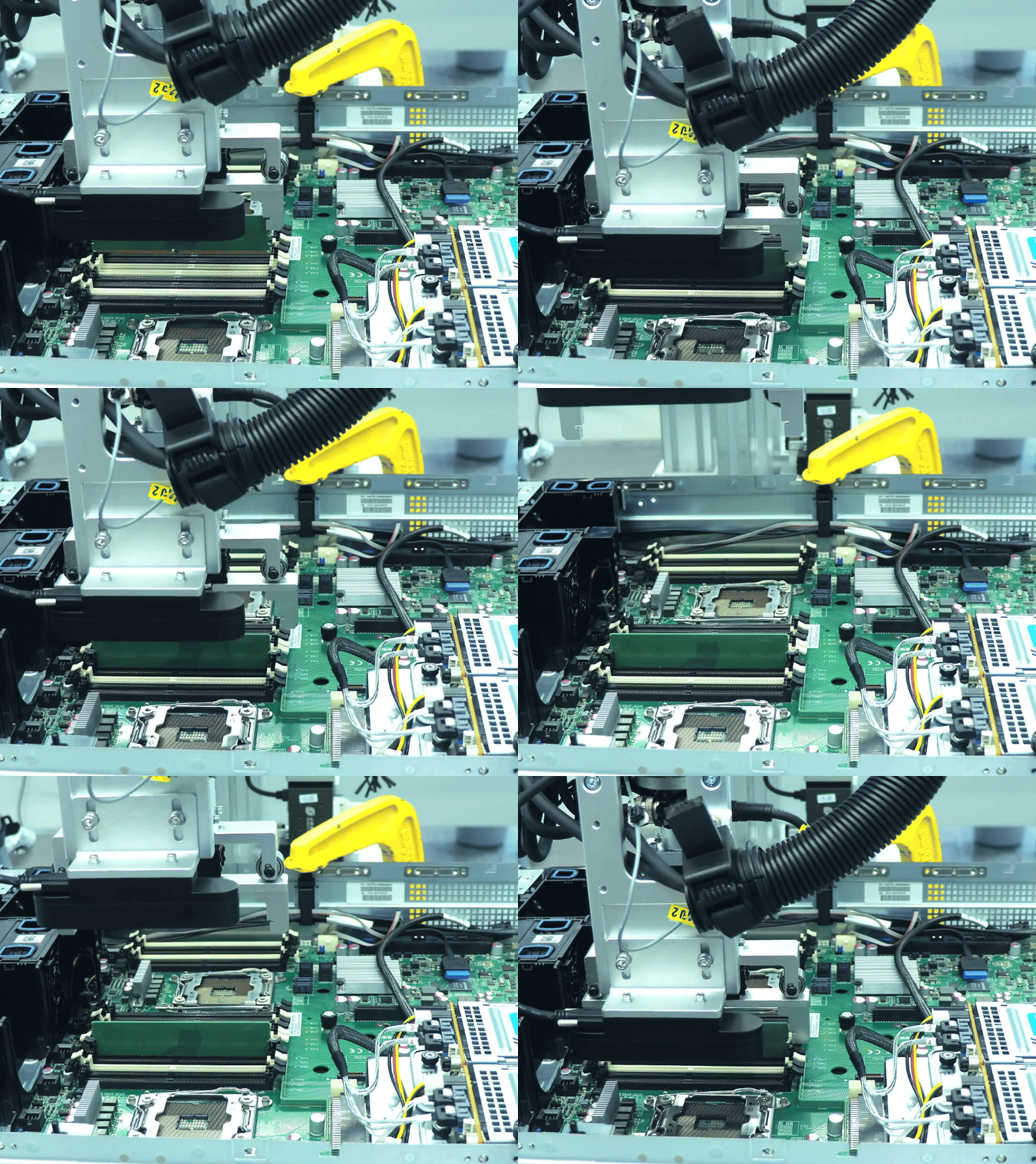
A force-controlled robot can respond instantly to contact forces during insertion and complete the operation more consistently. Alignment errors of 1/50, 1/25, or even an inch can often be accommodated as the robot “feels out” the seating location.
In real-life production environments the goal is not simply to reduce assembly time. It is to optimize the entire process, including successful insertion, error recovery, and quality verification.
NVIDIA’s research reinforces this point by treating success rate and cycle time as equally important performance requirements.
5.The Business Case
While the engineering advantages of force-controlled robots are countless, the advantages for business owners are often overlooked. Because the NVIDIA paper focused purely on the engineering side, the return-on-investment potential was understandably not covered.
ROI for a robotics installation is best evaluated through measurable manufacturing performance indicators, rather than assuming that introducing force control automatically improves production economics.
These performance indicators can be distilled to five core points:
a. Reduced Scrap: More controlled physical interactions can lower the risk of component damage and failed assembly operations. Manufacturers can track the impact through scrap rates, rework rates, and first-pass yield.
b. Improved Equipment Utilization: Reducing failed insertions and unnecessary recovery operations can minimize interruptions and may improve Overall Equipment Effectiveness.
c. More Efficient Deployment: Adaptive control can reduce the need to compensate for every variation through mechanical fixtures or extensive trajectory adjustments.
d. Greater Production Flexibility: Manufacturers frequently face evolving product designs, changing component configurations, and varying production requirements.
e. More Effective Allocation of Labor: Automating repetitive and physically demanding assembly operations can free experienced manufacturing personnel to focus on process supervision, quality assurance, troubleshooting, and production optimization.
Ultimately the business case for force-controlled robotics depends on the application. Some tasks will be worth the investment and others will not.
A combination of value-stream mapping, cost-benefit analysis, total cost of ownership evaluation, failure mode and effects analysis, and classic PESTEL and SWOT assessments will inform business owners whether automation is the right path for them.
6.HowAdaptiveRoboticsSupportAdvancedManufacturing
Flexiv’s series of adaptive robots are designed for applications that require a combination of precise movement and controlled physical interaction. This is why the Rizon 4s was ultimately selected for use by the NVIDIA team.
By combining dexterous manipulation with force-control, Flexiv’s Rizon series has automated tasks such as:
a. Precision connector insertion and assembly
b. Electrical component positioning and testing
c. Mechanical fixture installation and removal
d. FPC ribbon cable insertion
e. Material abrasion tasks with standard tools
f. Assembly processes involving variable contact conditions
g. Tasks requiring compliant interaction with workpieces
h. Food processing applications
Force-controlled robotics can automate tasks that would previously have required manual labor or extensive fixturing and process control.
The combination of positional accuracy, force feedback, and adaptive movement provides a foundation for developing more flexible production systems that are necessary to meet the evolving demands of the AI infrastructure build-out.
To learn more about how Flexiv can help you do more with less, why not contact us today?


